
Archive for the ‘Consumerism’ Category
Taking the road less traveled on consumption
This article first appeared in Sustainable Industries, September 28, 2010.
The latest drop in consumer confidence will no doubt discourage many businesses. After all, consumer spending comprises 70 percent of U.S. Gross Domestic Product.
If individuals have greater confidence in the future, they buy more stuff. Businesses make more money and hire more employees. That increases consumers’ ability to purchase more things, their confidence rises and the virtuous cycle continues.
Until it stops.
And stop it did two years ago this month after Lehman Brothers collapsed into bankruptcy and sent stock markets and the economy into a tailspin.
With today’s overall economy only modestly improved, we in business today find ourselves at a crossroads. Do we continue down the rutted but familiar road of a materialistic marketplace, hoping the road will soon smooth out? Or do we choose an alternate route to prosperity this time?
The dead end of material consumption
It didn’t take the Great Recession to teach many of us the path of consumption we’ve traveled for more than a century is ultimately a dead end. That’s been apparent for some time; we have only one planet to sustain our pace of natural resource consumption, and we need two or three at the rate we’re going.
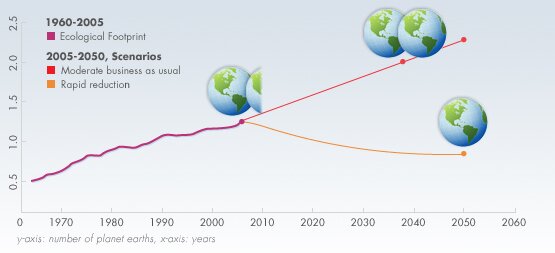
Source: Global Footprint Network
What isn’t apparent is whether our experience of the Great Recession will fundamentally change the way we do business. Ask yourself:
- Is your business hunkering down, waiting for the return of the free-wheeling, free-spending consumer?
- Or are you using this period to rethink your business model, what you produce and sell and how you measure success—consistent with a resource- and financially constrained age?
Confronting ‘the materiality paradox’
The last time we suffered a downturn like this was the early 1980s. When we emerged from that recession, Americans went on an unprecedented spending and consumption binge that continued largely unabated until two years ago.
The era gave rise to what sociologist Juliet Schor describes in her excellent new book, “Plenitude,” as “the materiality paradox.” That is, as products became more valued as “symbolic communicators,” they grew more reliant on fashion and novelty, speeding the cycle of consumption.
“People buy more products and turn them over more quickly,” she writes. The paradox is we value goods less today, but we consume more of them to satisfy our natural desire for social meaning and individual expression.
The non-material consumer economy
If past behavior is the best predictor of future behavior, then it’s likely Americans will return to what we do better than anyone: consume. But nowhere is it written that what or how much we consume has to be identical to the last 25 to 30 years. A consumer economy doesn’t have to mean “a-consumer-of-materials economy.”
Much of what individuals and businesses “consume” is far more about experiences than stuff, such as:
- education and training, of all types
- fine arts, crafts
- music, theater, dance and other performing arts
- movies, reading, sports and other entertainment
- travel
- hiking, bicycling, skiing and other recreational activities
- digital gaming and other virtual products
That isn’t to say these and other experiences don’t have associated sustainability issues. The business challenge is to dematerialize the production, promotion and delivery of these experiences as much as possible. But businesses enjoy a head start on sustainability when their core products are experiences instead of goods.
Makers of goods can gain a similar advantage through “cradle-to-cradle” techniques such as upcycling (turning waste material or other used or useless products into new, higher-value goods).
Design for environment and sustainable design practices minimize raw material use and waste. But the jury is still out on whether better, smarter design is the “silver bullet” solution to over-consumption. At some point the prevailing materialistic mindset also has to change.
The road less traveled
The point is: A consumer economy isn’t unsustainable by definition. It depends on what and how much gets consumed. Americans are deeply conditioned to satisfy their desire for happiness and meaning by accumulating possessions. This reflects the persuasive power of professions like mine — branding and marketing — more than some genetic predisposition to shop.
Dislodging materialism as the economic status quo won’t be easy. But if enough businesses choose the road less traveled, the next three decades will look far different from the last three.
Many sustainability leaders in business are already re-conditioning customers to consume less and differently. They respect the material limits of our planet. And they recognize what customers ultimately desire — happiness, security, belonging — isn’t found on store shelves and never goes out of fashion.

Tags: consumer confidence, consumer economy, Juliet Schor, materialism, materiality paradox, Plenitude, Sustainability, sustainable consumption
Posted in Branding, Business & Economics, Consumerism, Marketing, Sustainability | No Comments »
A question we’re not trained to ask
What is enough?
Good question. And one businesspeople rarely consider. I asked Massachusetts-based consultant Jen Cohen why.
Because you are trained to ask ‘How do I get more?’ You are not trained to ask the question (of enough). Success in business has historically meant constant accumulation. So why would you ask ‘What is enough?’ It is a heretical question, in the frame of Wall Street or the current business model. We need a model where there is room for that question.
Cohen and her business partner Gina LaRoche co-founded Seven Stones Leadership to help businesses and individuals explore the question of enough. They base their practice on the principles of “sufficiency,” an emerging area of consulting that proves to be a natural complement to sustainability.

Jen Cohen
I’ve had the good fortune of working with Cohen and LaRoche, both as a branding consultant and a client. I’ve learned that sufficiency, like sustainability, defies easy definition. LaRoche comes at sufficiency from multiple perspectives: “It’s a practice. It’s an inquiry. It’s a way of life. A challenge, a business model.”
Author Lynne Twist inspired an ongoing conversation on sufficiency with her 2003 book, The Soul of Money. Writing from 20 years experience as a successful fundraiser for nonprofits, she lays bare the myths of scarcity that most of us tell ourselves: there’s not enough, more is better, that’s just the way it is.
Cohen sees these myths play out daily in her work.
There’s not one person who comes into my office and tells the story about how sufficient they are. Not one person. The story that every single person who comes into my office tells is how they are swinging on the pendulum between inadequacy, not having enough, and excess.

Gina LaRoche
LaRoche says businesspeople avoid the question of enough as they do many tough questions. It comes down to what LaRoche calls “the diffusion of responsibility” prevalent among organizations. We tell ourselves, LaRoche says, “That’s not my problem. There’s someone else in charge. Someone else who can make that decision.” All the way up to the CEO who defers to the board.
The scarcity in sustainability
The language of the sustainability movement is often couched in terms of scarcity and excess: not enough clean air and water, not enough forested land, too much carbon pollution, not enough political will.
It isn’t a myth to say we live on a planet with finite resources. But that’s not the whole story, according to Twist. “Abundance is a fact of nature,” she writes. “It is a fundamental law of nature, that there is enough and it is finite.”
Seeing the world as abundant and finite, we revere the earth’s limited resources and pledge to manage them in a way that does the most good for the most people. From a mindset of scarcity, businesses and individuals believe there’s not enough for everyone. And may the fittest survive.
In a self-fulfilling act, the scarcity mentality drives us to make and consume more to be among the survivors, ensuring there indeed won’t be enough for all.
Marketers routinely capitalize on the pervasive sense of scarcity: Act now, supplies won’t last! Harvard marketing professor John Quelch is one proponent: “Creating the illusion of scarcity can be a smart marketing strategy.”
Valuing depth in business
Many companies are struggling with the loss of revenue, customers and employees as the recession wears on. If scarcity is our default setting, most businesses are in default mode right now.
One way to flip the switch is to imagine what operating a business from a sense of abundance, of having enough, of being enough would be like. Cohen says it would be fundamentally different. You would no longer privilege breadth or expansion, or be ruled by the axiom “if you’re not growing, you’re dying.”
I would say in a sufficiency model where the infinity rests is in depth: depth of richness, depth of interdependence, depth of creativity, depth of serving people. You can stay in the infinite possibility of your work making a difference in the world, or your work reaching people or your work mattering or your business mattering.
The practice of sufficiency works hand-in-glove with sustainability. Those of us striving to operate our businesses sustainably will not succeed if our constant guide is the experience of fear, scarcity, not enough. Even if I’m wrong, what’s the point of joyless sustainability?
So what is enough? Twist answers, “Each of us determines that for ourselves, but very rarely do we let ourselves have that experience.”
What better time than now?
Tags: Gina LaRoche, Jen Cohen, Lynne Twist, scarcity, Seven Stones, sufficiency, Sustainability, The Soul of Money, what is enough
Posted in Business & Economics, Communications, Consumerism, Marketing, Sustainability | No Comments »
Sustainable opportunity in a ‘culture of thrift’
A “culture of thrift” may be taking hold in the US. That scares the many businesses that depend on Americans resuming their profligate ways. But if you’re a business leading the way in sustainability, this consumer shift could be just the opportunity you’ve been waiting for.
A Pew Research Center survey in April found Americans of all stripes are reconsidering the luxuries and necessities in their lives. For instance, fewer of us consider microwave ovens, TVs, air conditioners and clothes dryers necessities. In addition, 80 percent of adults have made moves to economize one way or another in this recession, such as shopping at discount stores, eschewing name brands for cheaper alternatives and opting for lower-cost cell phone and cable/satellite TV plans.
Not surprisingly, those respondents hit hardest by the recession, such as losing their jobs or their retirement savings, are more apt to have taken cost-saving steps than those less affected. Even so, Pew Research says:
(T)his distinction doesn’t apply to changing perceptions about what’s a luxury and what’s a necessity. These shifts have occurred across-the-board, among adults in all income groups and economic circumstances — perhaps suggesting that consumer reaction to the recession is being driven by specific personal economic hardships as well as by a more pervasive new creed of thrift that has taken hold both among those who’ve been personally affected and those who haven’t.
Pew doesn’t speculate on whether this new consumer ethic is a long-term shift. The New York Times, however, says we shouldn’t be looking for Americans to return to spending like drunken sailors anytime soon. “The economic downturn is forcing a return to a culture of thrift that many economists say could last well beyond the inevitable recovery,” the paper reports.
Where the New York Times cites the pain this could cause businesses reliant on consumer spending, TIME magazine finds a silver lining for individual Americans:
A consumer culture invites us to want more than we can ever have; a culture of thrift invites us to be grateful for whatever we can get. So we pass the time by tending our gardens and patching our safety nets and debating whether, years from now, this season will be remembered for what we lost, or all that we found.
And what many people are finding in this painful recession is what’s really important in thelr lives: time, family, friends, community, learning, the security of living within their means, doing meaningful work. For businesses down the road to sustainability, this is your silver lining: You’re already where many of your customers are coming to and where they will expect businesses to be in the future.
Marketing consultant Avi Dan, addressing marketing strategists in Ad Age, says the period we are in now “represents a complete social and economic reset.” He writes:
As consumers learn to live within their means and frugality replaces an abundantly wasteful consumerism, sustainability will become an essential benefit to your customers. Customers will uncompromisingly penalize products and brands that are perceived as wasteful of scarce resources and harmful to the environment, from SUVs to bottled water.
Many, perhaps most, businesses are frightened by this prospect because they have so much catching up to do. Avi Dan is speaking to them when he says, “Marketers will risk being left behind if they don’t rethink everything.”
If you’re among those firms that got serious about sustainability some time ago, you’ve not only rethought — you’ve acted. So smile. The times are now on your side.
Tags: Ad Age, culture of thrift, luxuries vs. necessities, Marketing, Pew Research, recession, Sustainability
Posted in Business & Economics, Communications, Consumerism, Current Affairs, Marketing, Sustainability | No Comments »
Time to retire ‘green marketing’
With Earth Day 2009 behind us, I have a suggestion: Let’s acknowledge “green marketing” has outlived its usefulness and put our energy into redefining marketing itself.
Green marketing had a good run. It has responded to the rising green demands of customers. And it’s helped raise the environmental conscience of many others. Unfortunately, marketing as it’s most widely practiced remains the fuel for unsustainable consumption. And green marketing doesn’t go nearly far enough to change that.
The American Marketing Association (AMA) defines green marketing three ways:
- (retailing definition) The marketing of products that are presumed to be environmentally safe.
- (social marketing definition) The development and marketing of products designed to minimize negative effects on the physical environment or to improve its quality.
- (environments definition) The efforts by organizations to produce, promote, package, and reclaim products in a manner that is sensitive or responsive to ecological concerns.
I added the emphasis to products to underscore the limitation of green marketing. Absolutely, we must develop and promote products that are ecologically sensitive and safe. And green marketing has encouraged more eco-friendly product consumption. However, it utterly fails to address two unsustainable conditions:
- Too much consumption by rich people and countries: According to the World Wildlife Foundation, the ecological footprint* of the United States in 2005 was 9.4 (global hectares per person); the world average was 2.7. For high-income countries it was 6.4; for low-income countries 1.0.
- Too little consumption by poor people and countries: Although progress has been made on reducing extreme poverty in recent decades, the World Bank estimates that 1.4 billion people still lived on less than US $1.25 a day in 2005.
Over consumption and inequitable consumption explain much of what troubles our world. If marketers really want to make a difference, they’ll look far beyond green products. And focus instead on how to curb the material cravings of the affluent and narrow the rich-poor gap.
We’re seeing signs of green marketing morphing into “sustainable marketing.” That’s an improvement. It situates marketing in a larger triple-bottom-line context: people, planet, profit. Sustainable marketing, however, implies there is something known as “unsustainable marketing” — which of course there is, most anywhere you look.
We need sustainability embedded in marketing. In other words, marketing — by definition — must be sustainable. There is no green marketing or sustainable marketing. There’s only marketing. And it’s sustainable. Or at least that’s the idea.
What does sustainability mean? I rely on the widely used definition from the Brundtland Commission**: “Meeting the needs of the present without compromising the ability of future generations to meet their own needs.”
The AMA, meanwhile, defines marketing (inelegantly) as “an organizational function and a set of processes for creating, communicating, and delivering value to customers and for managing customer relationships in ways that benefit the organization and its stakeholders.”
So marketing newly defined could appear something like this:
Delivering value to customers and managing customer relationships in ways that meet the needs of the organization and its stakeholders without compromising the ability of all humans, present and future, to meet their own needs.
Still doesn’t roll of the tongue, I know. But this alternative concept of marketing is profoundly different. No longer will it be enough to satisfy our customers for their benefit and that of our organization and stakeholders (especially shareholders). This business-as-usual approach to marketing has created too few winners and too many losers.
The world could look very different if marketers accept responsibility for ensuring their organizations (or clients) are not jeopardizing the ability of others to meet their needs. In other words, doing our jobs can’t mean satisfying customers, shareholders or bosses at a cost to the health of individuals, communities and environments now and for generations to come. How we avoid that won’t always be obvious. The point is to acknowledge there can be broad social and ecological consequences to our actions and lines we don’t knowingly cross.
Don’t hold your breath waiting for the AMA and academia to get behind a new vision of marketing. They’ll follow the real practices of real marketers. Let’s show them the way.
*According to the World Wildlife Federation, “A country’s footprint is the sum of all the cropland, grazing land, forest and fishing grounds required to produce the food, fibre and timber it consumes, to absorb the wastes emitted when it uses energy, and to provide space for its infrastructure.” WWF also says, “If our demands on the planet continue at the same rate, by the mid-2030s we will need the equivalent of two planets to maintain our lifestyles.”
** Friend Brian Setzler at TriLibrium informs me two key concepts are usually excluded or overlooked when referring to the Brundtland definition: “the concept of ‘needs’, in particular the essential needs of the world’s poor, to which overriding priority should be given; and the idea of limitations imposed by the state of technology and social organization on the environment’s ability to meet present and future needs.”
Tags: American Marketing Association, Brundtland Commission, green marketing, inequitable consumption, over consumption, Sustainability, sustainable marketing, unsustainable marketing, World Wildlife Federation
Posted in Communications, Consumerism, Marketing, Sustainability, Uncategorized | 1 Comment »
The endless lengths marketers go to get us to buy
Recession be damned. If there’s a way to get people to part with their money, by God, marketers are going to discover and use it. Today’s example? Neuromarketing.
Apparently there’s no recession in Martin Lindstrom’s business, Buyology, Inc. His firm takes its name from his book “Buyology: Truth and Lies About Why We Buy.” Consumer products companies are flying him around the world to learn what he knows about what Marketing News calls “the last frontier of marketing research: the consumer’s subconscious mind.”
Lindstrom’s book, published in 2008, sets him up nicely as an expert on neuromarketing, which he says “is to use the latest brain science to understand the consumer’s behavior.” Or as his book title says, “Why We Buy.” (I confess I haven’t read it.)
Nobel Peace Prize winner and neuroscientist Eric Kandel has said the ultimate remaining challenge of the biological sciences is to “understand the biological basis of consciousness and the mental processes by which we perceive, act, learn, and remember.” In the last five years or so, this pursuit has spawned neuromarketing.
Just as marketers teamed with psychologists after World War II to create the field of consumer psychology, the largest brands are now looking to harness the methods and technology of neuroscience to study our brain responses to marketing stimuli. Neuromarketing is just the latest chapter in a long history of marketers learning to produce better and better-targeted marketing messages that will lead us to buy.
What struck me most about Lindstrom’s interview in the latest issue of Marketing News (no article link available yet) is this comment:
“My intention was to write a book so, hopefully, the whole world could engage in a debate and say: ‘Are we going too far? And if we’re going too far, should we have regulations around this?’ Now, here’s the bad news on this one. The ethical debate has not appeared so far.”
Lindstrom is right. There’s been no debate. But he’s not going to be the one to spark it, given he claims to work with 17 of the world’s largest brands, 12 of which are using neuromarketing. His vested interest is in seeing this new field flourish, not in drawing attention to its questionable reason for existence.
I would love to see a thorough debate of neuromarketing. Just as I’d welcome a public debate on the ethics of word of mouth marketing. But my concern is less with neuromarketing itself than with what it says about the marketing industry: Will there ever be an end to the lengths marketers will go to get us to buy? After neuromarketing, what’s next? Cloning loyal consumers of our brand? If you want some answers read journalist Lucas Conley’s superb book, “Obsessive Branding Disorder.” Or if you’re intrigued by neuromarketing, read the blog.
If humans hope to have a sustainable future, they must consume less. A lot less. A recession is one way to put a stop to buying. A better way is for the choice to be voluntary. What the world really needs is to understand how to trigger or train the subconscious mind to reject the marketing stimuli that entice us to buy more crap we don’t need and can’t afford.
Here’s a book waiting to be written: “DoNotBuyology: Truth and Lies about Why We Shouldn’t Buy.” If you write it, I’ll buy it. No MRI required.
Tags: brand, Branding, buyology, marketer, marketing research, neuromarketing, OBD
Posted in Books, Business & Economics, Communications, Consumerism, Marketing, Sustainability | Comments Off on The endless lengths marketers go to get us to buy
Greenwashing is just the tip of the marketing iceberg
Greenwashing is a regrettable practice across the business world today. And I applaud initiatives such as the Greenwashing Index to prevent the practice from spreading.
I’m concerned, however, that greenwashing may be distracting marketing executives and educators from an even more distressing matter: The vast number of companies, large and small, that even today don’t give lip service to green or sustainable products or practices. They don’t pretend to be sustainable, don’t promise to become sustainable, don’t understand what it means to be sustainable and, frankly, don’t appear to care.
The marketing and advertising of these companies remain what they’ve always been: attempts to promote and sell products and services, without a hint of green gloss. They stress the usual customer benefits: greater value, quality, innovation, convenience, luxury, responsiveness, ROI and the like. But they make no claims to be more earth-friendly, socially responsible or otherwise green or sustainable. These businesses continue to do what they’ve always done, with no obvious regard or accountability for the environmental or social impact of their actions now or across future generations, except perhaps as required by law, rule or regulation.
I don’t know what percentage of businesses are making concerted efforts to become far more sustainable. I’d wager it’s a small minority. One reason the media features companies that embrace sustainability is they are the exceptions. If every company was going green, there would be no story. And one reason businesses tout the “greenness” of their products or practices (sometimes resorting to greenwashing) is they see a competitive or “first mover” advantage. Again, if all companies produced sustainable goods or services, that advantage disappears.
The point is too few businesses are serious about sustainability today. And that should have brand managers, PR counselors, ad execs, social media mavens and all other marketers up in arms.
I don’t want to minimize the seriousness of greenwashing — no company should be allowed an advantage through false or deceptive marketing. But who should worry us more:
- The few unethical companies (and their marketers) trying to pull the green wool over our eyes? Or…
- The many businesses making truthful, “non-green” claims that contribute to excessive or inequitable consumption and their inevitable byproducts: natural resource depletion, ecological damage, climate change, poverty?
Marketers committed to sustainability have a perfect opportunity in this worsening recession to drive home a critical point among their not-so-green peers: It’s time to examine the very role of marketers in fueling unsustainable economies and ways of living. Or stated more positively, how marketers can get on the right side of sustainability.
Ridding the world of greenwashing would be welcomed progress. Harnessing the creative and persuasive talents of every marketer on behalf of a sustainable world would be nothing short of awesome.
Tags: advertising, brand managers, greenwashing, greenwashing index, marketers, PR, Sustainability, sustainable
Posted in Business & Economics, Climate Change, Communications, Consumerism, Marketing, Sustainability | No Comments »