
Archive for the ‘Uncategorized’ Category
Whose language is your business speaking?
Anyone who uses language in their work and business — and who doesn’t? — would do well to consider the perspective of evolutionary biologist Mark Pagel. Because chances are the language of your business is hurting more than helping your success.
Papua New Guinea, an island somewhat larger in size than California, is home to fewer than seven million people and more than 800 languages. There are places on the island where you can encounter a new language every two to three miles, according to Pagel. Some would say that’s cultural diversity at its finest. Pagel would say it’s “very peculiar, even bizarre.”

Source: petersbar via Flickr
The reason? Humans, Pagel said in his TED talk last month, originally devised language some 200,000 years ago as a means of sharing ideas, knowledge and wisdom. “Language is a piece of social technology for enhancing the benefits of cooperation,” Pagel said. So it was “bizarre” that humans should have gone on to create thousands of different languages. (more…)

Tags: business communications, language, language barriers, language of busienss, Mark Pagel, social media, social networking, speakkng your customers language, TED Talk
Posted in Business & Economics, Communications, Marketing, Uncategorized | No Comments »
10 steps to building a sustainable brand
An editor recently asked me to share how an organization could build a sustainable brand. I offered a 10-step approach for any business or nonprofit on the sustainability path. I’m curious what additions or changes you would make to this list: (more…)
Tags: 10 steps, brand identity, brand marketing, brand research, employee engagement, mission statement, sustainability plan, sustainable brand, sustainable branding
Posted in Branding, Communications, Marketing, Sustainability, Uncategorized | No Comments »
Don’t know your customer? Look in the mirror
After several hours of questions and conversation earlier this week, my clients and I seemed only somewhat closer to nailing down their target customer. Then the business development manager shared a customer profile they drafted a couple months earlier. Funny thing, he could have just as easily been describing the people in his company.
Could it be that to know thyself is to know thy customer? At the very least, it’s a great place to start when your profiling a target audience. (more…)
Tags: Branding, business, business development, customer development, customer profile, nonprofit, target audience
Posted in Branding, Communications, Marketing, Uncategorized | No Comments »


Greater sin: greenwashing or ignoring sustainability?
A business that strives to be sustainable but falls far short on its sustainability promises is committing “a greater sin” than a business that ignores sustainability but keeps its promises. That’s one of the findings of the new Sustainability + Branding Survey of sustainability advocates in business.
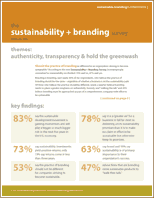 My partners and I in the Sustainable Branding Collaborative have released a summary report of the survey, which we conducted in late 2010. I encourage you to download a copy and see what your peers have to say.
When asked which is the “greater sin,” 78 percent of respondents said it’s worse for a business to make an effort to become more sustainable but allow its publicized promises on sustainability to far exceed its actual practices. Only 22 percent said it’s a greater sin for a company to make no claim or effort to become sustainable but otherwise deliver on all of its promises.
What’s clear from the survey is business executives committed to sustainability loathe greenwashing and value integrity. The findings validate the importance our group’s branding approach places on ensuring the sustainability practices of your employees and organization deliver what your brand promises.
Branding advice from sustainability proponents
The survey respondents’ top pieces of advice for companies branding more sustainable products and services include:
- Be honest, be authentic, “walk your talk”
- Build a solid sustainability foundation using methods such as The Natural Step Framework, whole systems thinking and triple-bottom-line accounting
- Measure, verify and certify sustainability claims, preferably using a third party
- Look at branding as a critical foundation for business success, not as a luxury
Does sustainability change branding?
Among other findings, respondents were almost evenly split on the question of whether the practice of branding should be different for an organization that is striving to become sustainable: 53 percent said no, 47 percent said yes.
Branding is branding, say the respondents who believe the practice of branding should be the same — regardless of whether a business is on the sustainability path. Those who believe the practice should be different say sustainable brands need to place a greater emphasis on authenticity, honesty and delivering on the brand promise than traditional brands do. They also believe branding must be approached as part of a comprehensive, company-wide effort to be sustainable.
No matter how you go about branding your business or product, the values of honesty, transparency and keeping your promises are paramount. Whether you believe these values can be instilled through traditional branding methods or require new approaches, the sustainability proponents in this survey strongly advise you to do what you say.
About the survey
The Sustainable Branding Collaborative conducted the Sustainability + Branding Survey November 10-17, 2010. The survey gathered online responses from 291 innovators and early adopters in the sustainable business movement.
Tags: authentic branding, Branding, branding survey, greenwashing, Sustainability, sustainability survey, sustainable branding, Sustainable Branding Collaborative
Posted in Branding, Communications, Marketing, Sustainability, Uncategorized | No Comments »
Like sustainability, branding needs image change
A new study indicating the recession has crowded out concern for the environment prompted the New York Times to ask: “Is ‘thinking green’ an economic luxury?”
Uh, yeah. Not that it should be. If ever there was an economic necessity it would be to think green and adopt sustainable practices. But that’s just me speaking. My professional niche is sustainable branding, so I see business through the lens of sustainability. Plenty of recent studies show the continued gap between intention and action on sustainability among individuals and businesses.  Neither thinking nor acting green is considered essential.
Like sustainability, branding is viewed as a luxury by most in business. Ironically, that’s farthest from the truth in lean times like these. When acquiring and keeping customers is hardest, a business can least afford to ignore what creates competitive distinction and customer relevance — namely, its brand.
Branding’s image problem
Branding suffers from an enduring image problem. Mention branding, and dollar signs come to the minds of most executives. In a recession, that’s a show-stopper. The problem is branding is equated with design, advertising, marketing communications — all of which cost money. But brand promotion is only part of the branding equation — the most expensive part.
Yes, at some point, you have to build brand awareness, preference and loyalty. And that requires a financial investment in marketing. But the most essential components of building your brand — defining what it is and baking it into your culture, operations and products — are really just best management practices.
Branding is little different from other standard best practices, such as developing financial budgets, employment policies or product development plans. Sure they take some time and money to produce, but that’s simply the requirement of being in business, no matter the economic climate. So it is with branding.
When businesses declare branding a luxury they can’t afford, they are unwittingly saying, “We aren’t going to take the time to decide who we are as a business, what we stand for, what makes us distinct and why we matter as a company. And we’re not going to worry about whether we as managers and employees are keeping our promise as a business to customers and all our other stakeholders.”
Consequences of brand neglect
I used the word “unwittingly” because I don’t believe most business executives understand the consequences of neglecting their corporate brand until more prosperous times return.
 It’s one thing to slash advertising budgets or postpone the redesign of the firm’s visual identity. It’s quite another to lose sight of what makes your business distinct and relevant now, today, in an economy fundamentally different from just two years ago. Or to postpone accountability for whether your business is consistently delivering the customer experience you promise.
From the inside looking out, your brand is your over-arching promise to stakeholders. From the outside looking in, your brand is the image stakeholders have of your business, based on direct experience or word-of-mouth. Any business with customers or employees has a brand image. The question is whether the business understands and cultivates that image or leaves the task to others, such as competitors who are only too willing to tell your story for you.
At its most basic, branding means ensuring the experience aligns with the promise. That’s not accomplished by simply spending more money on clever advertising or glitzy marketing events. Much more important is being clear about what your promise is as a company and how your employees, products and practices deliver on it day after day, regardless of the economy.
Branding as necessity
Seen from this perspective, branding is no luxury. And it doesn’t have to be about spending big bucks. What it does require is time and commitment from senior leadership to ensure the brand:
- firmly establishes competitive distinction and customer relevance
- is understood and fulfilled across the company
- is positively perceived by customers, employees and other key stakeholders
Branding is an all-company, everyday exercise in earning and keeping customers and creating competitive advantage. When times are toughest, attention to your brand becomes more crucial than ever.
Does branding need to be on your list of business necessities? If so, I invite you to get in touch and explore how to make that happen.
Tags: brand image, brand promise, Branding, business luxury, customer experience, economic luxury, Freakonomics, Sustainability
Posted in Branding, Business & Economics, Communications, Marketing, Sustainability, Uncategorized | No Comments »